Educational article
Planning to Have Children? What to Discuss Before Using Testosterone

Educational content. It does not replace an individual medical assessment and should not be used for self-medication.

How are testosterone and fertility related?
Testosterone has important functions in the body, but testosterone given from outside the body—for example, as treatment for hypogonadism—can reduce the hormonal signals that stimulate sperm production in the testicles. In some people, the sperm count decreases considerably, or sperm may not be detected in the semen during treatment. The effect varies from person to person.
Fertility and sexual function are not the same
Fertility depends on various factors, including sperm production. Sexual function includes aspects such as sex drive, erections, and sexual activity. Although these aspects may be related, one does not determine the other: having a sex drive or erections does not confirm that sperm production is normal, and sexual difficulties alone do not establish a person’s fertility status.
When should you bring it up?
Wanting to have children now or in the future is reason enough to discuss fertility with your healthcare professional, even if you have no symptoms. It is also important to bring it up if you are already receiving testosterone and are thinking about trying to conceive with your partner, if you have had difficulty conceiving, or if you have concerns about your reproductive or testicular history. Sperm production cannot be determined just by how you feel.
Discussing it before you start may change the plan
Before starting testosterone, let your healthcare professional know whether you want to have children and your approximate timeframe. If you have already started, tell your healthcare team that reproductive planning is important to you before continuing or making any changes. This discussion allows you to review the diagnosis, your goals, and alternatives that may be relevant; there is no single option that is right for everyone.
What an evaluation may involve
Depending on your situation, your healthcare professional may review your medical history, symptoms, medications, and hormone tests. If sperm production needs to be assessed, they may consider a semen analysis and other evaluations. Your care may involve endocrinology, urology, or reproductive medicine. Your healthcare team will determine which tests are needed and how to interpret the results in your situation.
Options depend on the cause and your goals
When fertility is a priority, different clinical options may be considered. Their appropriateness depends on the cause of hypogonadism, the evaluation results, and when you want to have children. Talk with your specialist about the benefits, limitations, and possible effects of each alternative. No option can guarantee a reproductive outcome.
Do not stop or change treatment on your own
Do not stop, replace, or change testosterone without medical guidance. Recovery of sperm production after changing or stopping testosterone varies from person to person and is not necessarily immediate; an individual timeframe cannot be assured, nor can recovery be guaranteed. Testosterone should not be considered a contraceptive method either.
How to seek guidance in Colombia
You can ask your healthcare network which professional and care pathway are appropriate for your situation, such as endocrinology, urology, or reproductive medicine. Bring your reproductive plans and a list of the treatments you use to your appointment. Confirm availability and coverage with your healthcare network.
When to seek medical care
If symptoms persist, test results are abnormal, or you have questions about medication, arrange an individual assessment. Do not change treatment or doses without medical guidance.
Frequently asked questions
Does testosterone always cause infertility?
The effect cannot be said to be the same for everyone. Testosterone given from outside the body can reduce sperm production and affect fertility; its effects require an individual evaluation.
If I stop testosterone, when will my fertility recover?
Recovery and the timeframe vary from person to person and cannot be predicted by a general rule. Do not stop treatment on your own; consult a healthcare professional to review your goals and evaluation options.
Can I have a sex drive and still have low sperm production?
Yes. Sexual function and sperm production are distinct aspects. Assessing fertility may require a medical history, a clinical evaluation, and, when appropriate, a semen analysis.
Does this topic resonate with you?
Every case is different. Book a consultation to review your history, test results and goals with a personalized plan.
More articles about Male hormonal health

5 min de lectura
Publicado: 30 de octubre de 2026 · Actualizado: 30 de octubre de 2026
Low Testosterone: What Medical History Makes a Consultation Useful, Even Without Clear Symptoms
Sleep apnea, certain medications, and some testicular conditions or treatments may be relevant when evaluating testosterone. Learn what medical history to mention and why none of it confirms a diagnosis or

5 min de lectura
Publicado: 24 de octubre de 2026 · Actualizado: 24 de octubre de 2026
One Bad Week Does Not Reveal Your Hormones: How to Tell a Temporary Variation from a Persistent Change
Sleep, energy, and performance can vary for many reasons. Learn how to observe changes over time without assuming they are caused by a hormonal problem, and when to seek an evaluation.

5 min de lectura
Publicado: 24 de octubre de 2026 · Actualizado: 24 de octubre de 2026
Shift Work and Men’s Hormone Testing: Coordinate Timing and Results
If you work shifts, learn what information about your work schedule and rest may be useful when coordinating hormone testing, and how to ask about preparation and follow-up.

5 min de lectura
Publicado: 17 de octubre de 2026 · Actualizado: 17 de octubre de 2026
After a Hospitalization: What to Review Before Resuming Hormonal Follow-Up
What to review in your discharge summary, medications, and test results before resuming follow-up for male hormone therapy.

5 min de lectura
Publicado: 9 de octubre de 2026 · Actualizado: 9 de octubre de 2026
Using Testosterone on Your Own: Symptoms After Use That Require Prompt Attention
Recognize symptoms such as chest pain, significant difficulty breathing, or sudden weakness that require emergency care during or after testosterone or anabolic steroid use.
5 min de lectura
Publicado: 4 de septiembre de 2026 · Actualizado: 4 de septiembre de 2026
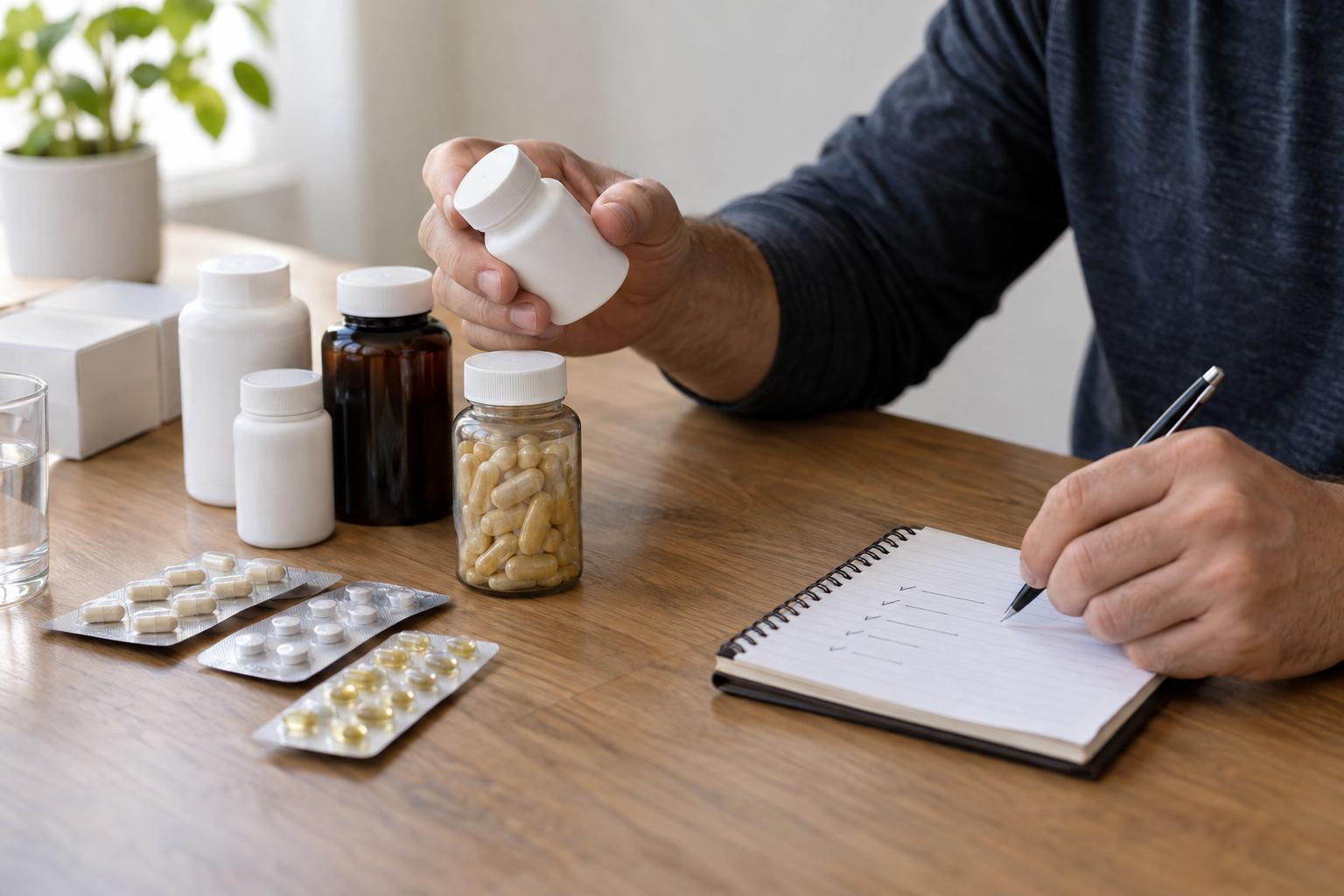
Medications, Supplements, and Hormones: What to Report When Evaluating Your Hormonal Health
Learn which medications, supplements, and hormone treatments to include in your medical history when evaluating male hormonal health, and how to organize this information without stopping treatments on your own.